
'Marathwada is the suicide capital of Maharashtra.' 'To stop such man-made disasters, the government should immediately come up with a rightful package, not this charitable approach to compensation.'

The average Indian worker must labour for an extraordinary 160 full working days to afford Apple's latest iPhone 17 Pro.
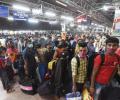
'When you compare Bihar's poverty from its earlier times, then there is a huge difference. Things have improved a lot. And migration has played an important role in reducing poverty.'

The textile and apparel sector is India's second-largest employment provider, after agriculture, and it is now caught in a wave of uncertainty following the Donald Trump administration's tariff policy.

Farming and agriculture are crying out for a business model innovation, says R Gopalakrishnan.

Under the Eknath Shinde government's flagship 'Mukhyamantri Majhi Ladki Bahin Yojana', eligible women in the state will be given Rs 1,500 per month.

India must do away with policy paralysis to ensure growth in agriculture.

The need for a manufacturing policy, reining in food inflation and raising investment in the country were among key suggestions given by economists who met Finance Minister Nirmala Sitharaman and senior ministry officials in the first round of pre-Budget consultations on Friday.

'The Bhashini Mission has delivered a working technology at large scale, which is as good as or better than the one with MNC tech giants.'
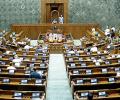
Bharatiya Janata Party on Thursday issued a three-line whip to all of its Lok Sabha MPs asking them to be present in the House for the passing of the Union Budget 2025-26.

Flagging the challenge of raising foodgrain production, Prime Minister Manmohan Singh on Friday promised all assistance to states for improving agricultural growth.

Simplifying investment policies at the micro level and introducing a time-bound framework will be critical for India's growth targets, notes Krishna Ella.
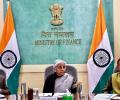
The Budget assumes significance as it comes on the back of lower-than-expected growth numbers during the second quarter and geopolitical uncertainty.

Finance Minister Nirmala Sitharaman on Tuesday asked fintech firms to focus on risk management at a time when criminals are using AI to mimic voices, clone identities and create lifelike videos to manipulate people.
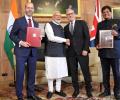
'That way you're not hostage just to US sort of exports to India.'

These are the highlights of the Union Budget 2025-26 presented by Finance Minister Nirmala Sitharaman in Parliament on Saturday.

Finance Minister Nirmala Sitharaman's Budget proposals lay out a comprehensive road map for transforming India into a developed nation, focusing on key priorities that aim to generate ample opportunities for all citizens in "Viksit Bharat". It sets the stage for sustained economic growth, social development, and technological advancement.

There are challenges galore before him, and it is not going to be easy. In the next four years, he has to conjure a system that changes the optics about him and the BJP both nationally and internationally so that he can ride back on his own, claim the top slot, and not have to lean on a coalition, asserts Ramesh Menon as Modi 3.0 completes a year in power.
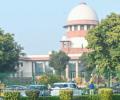
The Supreme Court on Wednesday deprecated the practice of announcing freebies prior to elections, and said people were not willing to work as they were getting free ration and money.
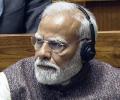
Prime Minister Narendra Modi has lauded the Union Budget as a "people's budget" that fulfills the dreams of every Indian and said that it is a "force-multiplier" that will boost consumption, investment and growth. He highlighted a host of measures for different sectors, including welfare initiatives for gig workers, tax relief for the middle class, and support for the manufacturing sector.

MNREGS labourers are usually engaged in irrigation projects.

The most striking features of this Budget was its focus on simplification and improving the ease of doing business in India, asserts Kaku Nakhate.
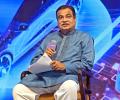
'I am not an aspiration-oriented politician.' 'This is the time to redefine politics.' 'Politics of power is not real politics.'

The finance minister, in her Budget speech, should focus more on what she is directly responsible for, rather than on programmes where her role is largely supportive, notes Nitin Desai.

Prime Minister Narendra Modi on Friday slammed the Aam Aadmi Party as an 'aapda' (disaster) for Delhi, saying this 'aapda' had taken the national capital in its grip in the past 10 years.

The International Monetary Fund (IMF) has slapped 11 new conditions on Pakistan for the release of the next tranche of its bailout programme and warned that tensions with India could heighten risks to the scheme's fiscal, external, and reform goals, according to a media report on Sunday.

Presenting the Budget for 2020-21, Sitharaman said Rs 1.7 lakh crore has been provided for transport infrastructure in 2020-21.

The government will formulate a strategy to make India self-reliant in edible oils by boosting domestic output of oilseeds and launch a comprehensive programme to support dairy farmers, Finance Minister Nirmala Sitharaman announced on Thursday. India imports a large quantity of edible oils to meet the domestic demand. During the 2022-23 marketing year (November-October), the country imported nearly 165 lakh tonnes of cooking oils, valuing a whopping Rs 1.38 lakh crore.

The scheme, which would give Rs 6,000 to small farmers in a year or Rs 500 a month, will add more money to the account of these cultivators than the money he/she saves every month on an average.

Launching the scheme, Modi said during the nationwide lockdown, the talent from cities returned to villages and it will now give a boost to development of rural areas. The 'Garib Kalyan Rozgar Abhiyaan' will be implemented on a mission mode in 125 days in 116 districts of six states -- Bihar, Madhya Pradesh, Uttar Pradesh, Rajasthan, Jharkhand and Odisha -- that received the maximum numbers of migrant workers back.

'Given our turbulent neighbourhood, the prime minister is likely to emphasise on democratic dividend as the reason behind India's continuous prosperity.'

An increase in the farmer income support scheme PM Kisan Nidhi, the introduction of a 'robot tax' to fund reskilling of people who lose their jobs to artificial intelligence (AI), and a reduced income-tax (I-T) to bring relief to the middle classes - these are some of the items in the Budget wish list submitted by Sangh Parivar affiliates to Finance Minister (FM) Nirmala Sitharaman. Representatives of the affiliates of the Rashtriya Swayamsevak Sangh (RSS), such as the farmer organisation Bharatiya Kisan Sangh (BKS); trade union Bharatiya Mazdoor Sangh (BMS); Laghu Udyog Bharati, which works for micro and small industries; and Swadeshi Jagran Manch (SJM), which works on economic and policy issues, met the FM and other officials over the last couple of weeks as part of the pre-Budget consultations.

Intern-Zip will teach 'technical savviness', soft skills and professional development. It would skill individuals in Microsoft Office and ChatGPT. It will include communication, problem-solving, time management, professional grooming, and networking.
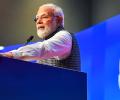
The Indian Diaspora has been able to carve a niche in their adopted countries as a result of their talent, perseverance and hardworking nature, asserts Rup Narayan Das.

The scheme is in the lines of Nabard's self-help group bank linkage programme, which is recognised as one of the largest microfinance programmes in the country.

The National Informatics Centre uses AI to automate document analysis and detect fraud in government departments.
Between April and September 2014, the central govt released Rs 13,618 cr to states, against Rs 24,676 cr in the same period last year.

According to official statistics, half of India's GDP comes from as many as 420 million workers in the unorganised sector including street vendors, rickshaw pullers, construction workers, rag pickers, agricultural workers, among others. This massive workforce remains outside the purview of the formal banking and insurance industries.

The Indian economy needs to generate an average of nearly 78.5 lakh jobs annually until 2030 in the non-farm sector to cater to the rising workforce, according to the Economic Survey for 2023-24. The Survey tabled in Parliament on Monday also laid emphasis on the private sector's role to create employment in the country saying "In more than one respect, the action lies with the private sector. "In terms of financial performance, the corporate sector has never had it so good."

President Droupadi Murmu on Wednesday emphasised the need to strengthen affirmative action as a tool for inclusion while urging the rejection of divisive tendencies rooted in perceived social hierarchies.
